村屋、獨立屋戶外走線:揀裝甲線定燈喉?Outdoor cable runs at a house: armoured cable or PVC conduit?
同一條路線,兩種做法,價錢差一截。分別不在於「哪一種比較好」,而在於那段線會曬到太陽、淋到雨、被車碰到,還是三樣都不會。Same route, two ways of doing it, and a real price gap. The question isn't which is better — it's whether that stretch of wall gets sun, rain and the occasional bumper.
At a village or detached house, the meter is usually on one side and the bay on the other. The fifteen-odd metres in between is the part of the job that most affects how the house looks — and how long the installation lasts.
There are two ways to do it: armoured cable (SWA, or steel-tape-armoured XLPE) clipped straight along the wall, or PVC conduit fixed to the wall first and the cable drawn through it afterwards.
Both are compliant. We do both. What decides it is the environment that stretch of wall is in.
Armoured cable: the protection is in the cable
Armoured cable clipped directly to the wall and along the patio edge. The inset is a section through it: UV-resistant outer sheath, steel wire armour, then four copper cores.
From the outside in: UV-resistant sheath → steel wire or tape armour → bedding → insulation → copper conductors. The protection is part of the cable, so wherever the cable goes, the protection goes with it.
Use it when
the run is long (over 10m) and crosses corners, patios or garden edges;
it's in full sun with no shelter;
it's at a height something can hit — a bumper, a bike, a strimmer, a dog;
it has to pass through soil or a concrete slab (it can be buried direct, at the depth the regulations set, with marker tape);
the route is permanent and won't be altered later.
Watch for
The armour must be earthed. Correctly sized glands at both ends, with the armour bonded through to the earthing system. Armoured cable held on with plastic clips and no gland is common, and not acceptable.
There's a minimum bending radius. Corners have to be swept, not folded.
It looks like a thick black cable running along your wall. If that isn't acceptable, this isn't your answer.
Both the material and the labour cost more than conduit.
PVC conduit: the protection is on the wall
Conduit entering an isolator. The joint between the conduit and the enclosure has to be sealed, or water runs down the tube and straight into the box.
Conduit means fixing a PVC tube first and drawing cable through it. The protection belongs to the tube on the wall, not to the cable.
Use it when
the run is short — a few metres, say from the indoor board through the wall and down to an isolator beside it;
it's under an eave, shaded, or indoors and semi-indoors;
appearance matters — white conduit can be painted to match the wall and disappears far better than black armoured cable;
the cable may need to be pulled, added to or replaced later. This is conduit's real advantage.
Watch for
UV. Ordinary white PVC conduit in Hong Kong sun yellows, embrittles and cracks within a few years. Anywhere in full sun needs UV-rated conduit — or armoured cable instead.
Water. Unsealed joints, bends and entries let rain run the length of the tube and pool at the lowest point, or in the isolator. Outdoor runs need a drainage point at the bottom.
Impact. PVC stops a finger, not a reversing car. Low down near the bay or a walkway, conduit needs additional mechanical protection.
Heat. Several cables in one conduit derates their current-carrying capacity, and that calculation is not optional for a charger — this is a load that sits at full current for hours.
Side by side
Armoured cable
PVC conduit
Where the protection is
In the cable
In the tube on the wall
UV
Sheath is UV-resistant
Needs UV-rated grade, or it embrittles
Water
Cable is inherently weatherproof
Depends on sealed joints and drainage
Impact
Good
Moderate; needs extra protection low down
Direct burial
Yes, to the regulations
Generally needs additional ducting
Long runs
Well suited
Many joints, many failure points
Replacing cable later
Pull a whole new run
Draw it out and back
Appearance
A thick black cable
White, paintable, tidier
Cost
Higher
Lower
How we actually decide
On a survey we're really asking three questions:
1. Is this stretch sheltered?
Full sun and rain → armoured. Under an eave or indoors → conduit is fine.
2. At this height, can anything hit it?
In front of the car, either side of the bay, below knee height along a path → armoured, or conduit inside a metal sleeve. Two metres up → conduit is fine.
3. How long is it, and how many corners?
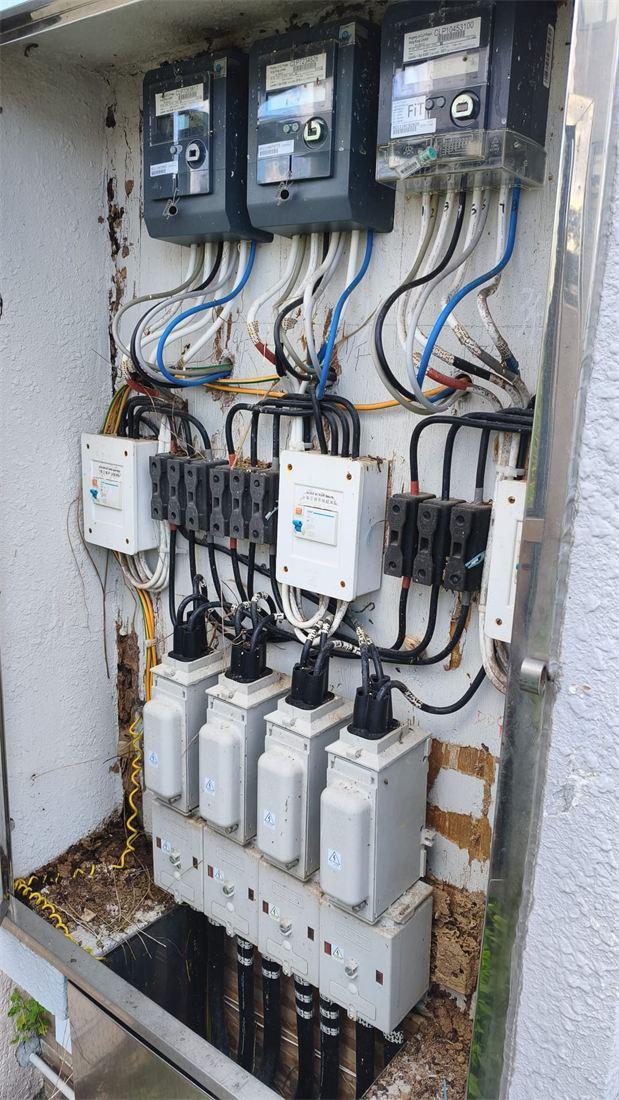
Fifteen or twenty metres, several corners, down to the slab and back up → one continuous armoured run, fewest joints. Three or four metres in a straight line → conduit is faster, neater and cheaper.
The most common answer is both: conduit from the indoor board to the wall penetration, armoured cable for the exposed stretch outside, then into a weatherproof enclosure at the bay. Nothing says one route has to be one method.
Three mistakes we see most
Indoor-grade white conduit on a west-facing wall. Looks fine for a year. By the third, it crumbles when you press it.
Armoured cable terminated without glands. Unearthed armour is a steel layer doing nothing — and if an internal fault reaches it, that "metal tube" on your wall is live.
No drainage in the conduit. Rainwater gets in, can't get out, and ends up in the isolator or the bottom of the charger. Hong Kong rain doesn't take long to prove the point.
All three fall under the visual inspection that happens before the installation is energised — they should be caught before the WR1 is ever signed.
Run length and price
Our village house installation price is based on a run of 10m or less, meter to bay. Beyond that we price by the actual length — and a long run is usually where armoured cable earns its cost back anyway, in fewer joints and less rework.
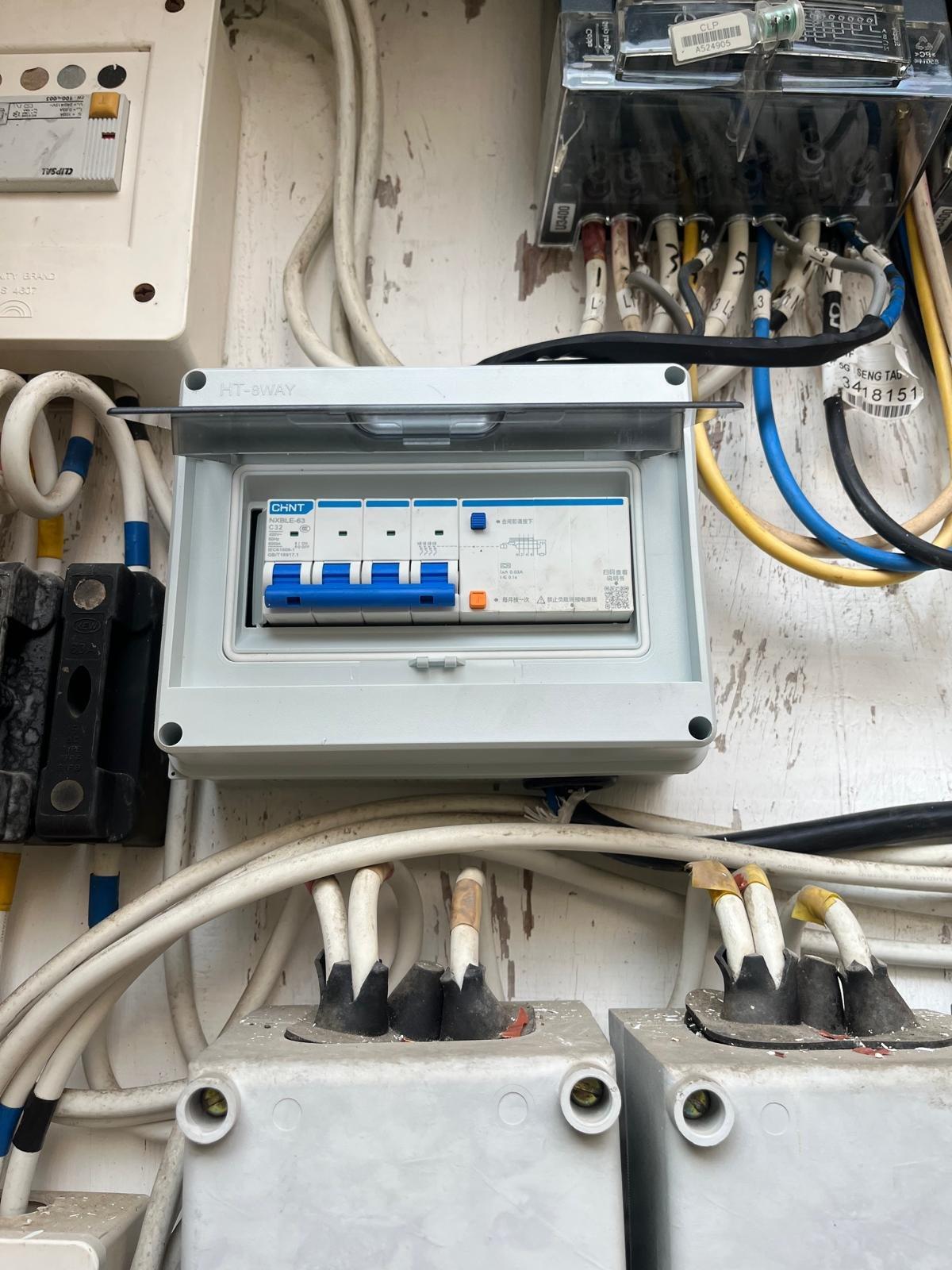
Want to know roughly how long yours is and which method suits? Photograph the meter box, photograph the bay, then take a short video walking the route between them, and WhatsApp it to us. If we can see the site, we can answer.
Armoured cable for the stretch that gets sun, rain and bumpers. Conduit for the stretch that's sheltered, short, and wants to look tidy. Using both on one route is entirely normal.
有問題想查詢?Got a question?
不一定要幫襯才可以查詢。傳送你的情況給我們,我們一樣會回答。You don't have to be a customer to ask. Send us your situation and we'll answer anyway.

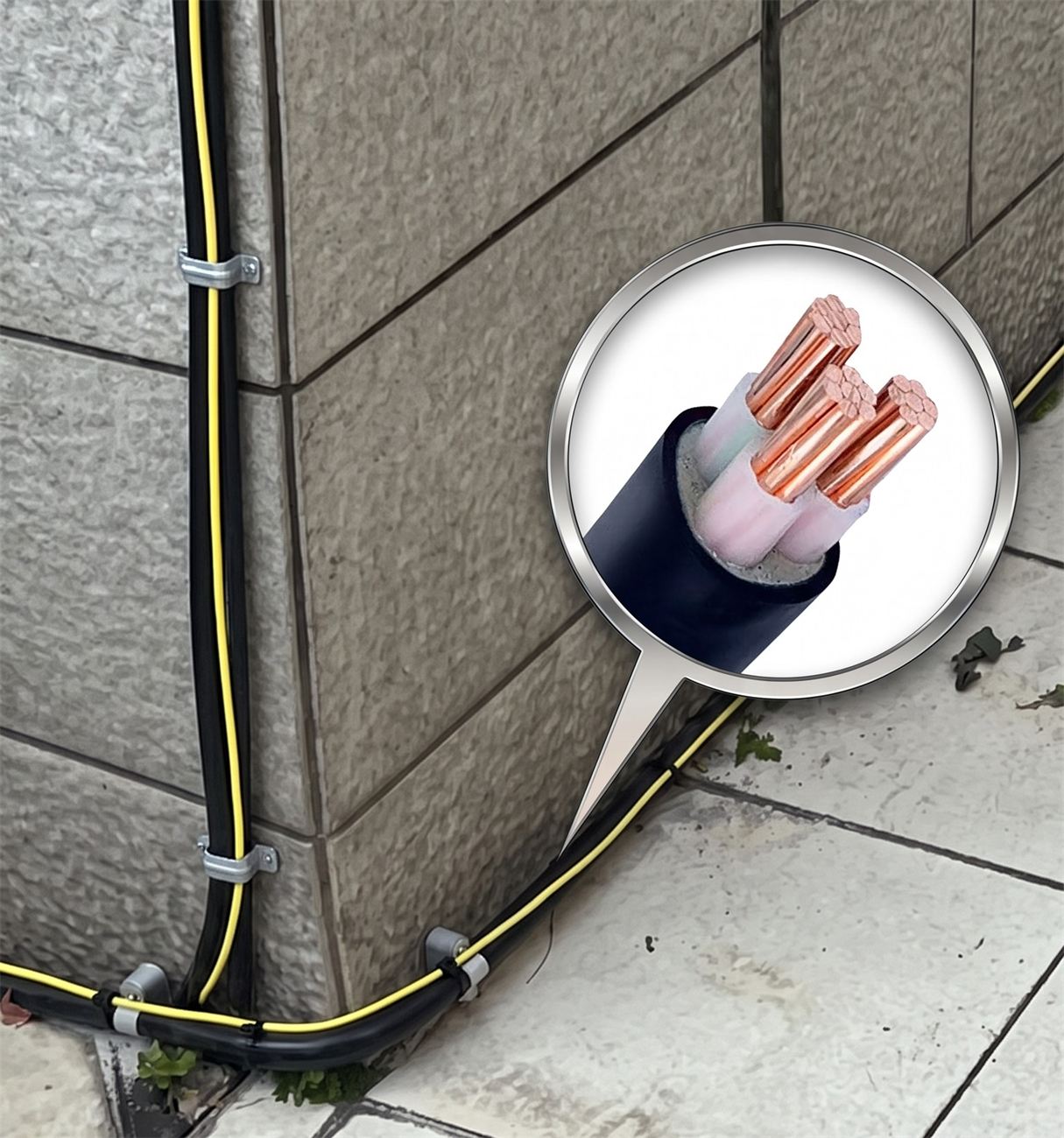 裝甲線用線碼直接夾在牆身及地台邊。放大的是電纜切面:外面黑色護套,中間一層鋼絲鎧裝,裏面四條銅芯。
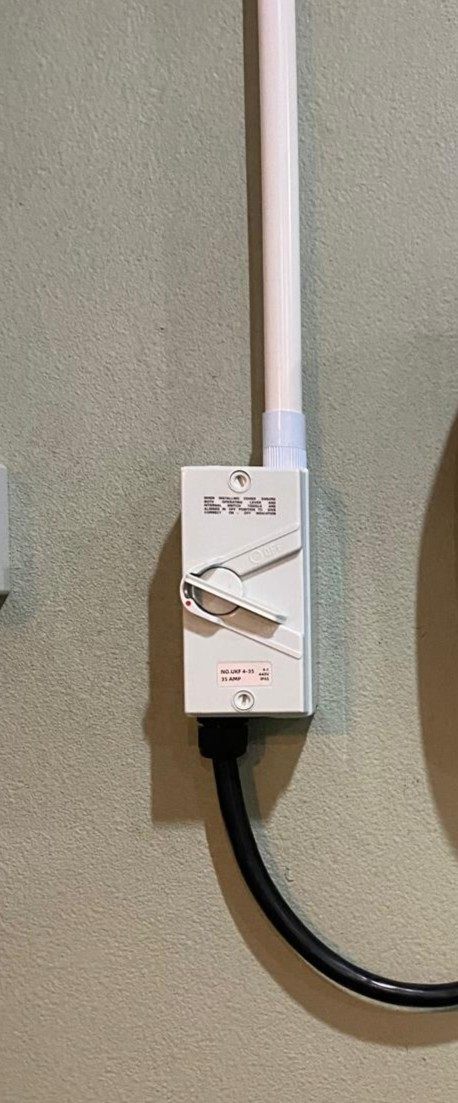 燈喉入掣箱的做法。留意喉咀同掣箱之間要密封,否則水會沿喉管流入箱內。